
Readers can leave comments on our websites, and most of the comments we publish are questions from people looking for help. In the 30 days to 17 November 2026, our server received 174,923 comment submissions. Our filtering, which relies heavily on AI to make the final call, found that just 135 of them were genuine, and those were published across our 338 sites. That is about one real comment for every 1,300 attempts. This is how we sort one from the other, what each layer catches, what it costs, and where we got it wrong.
The scale of it
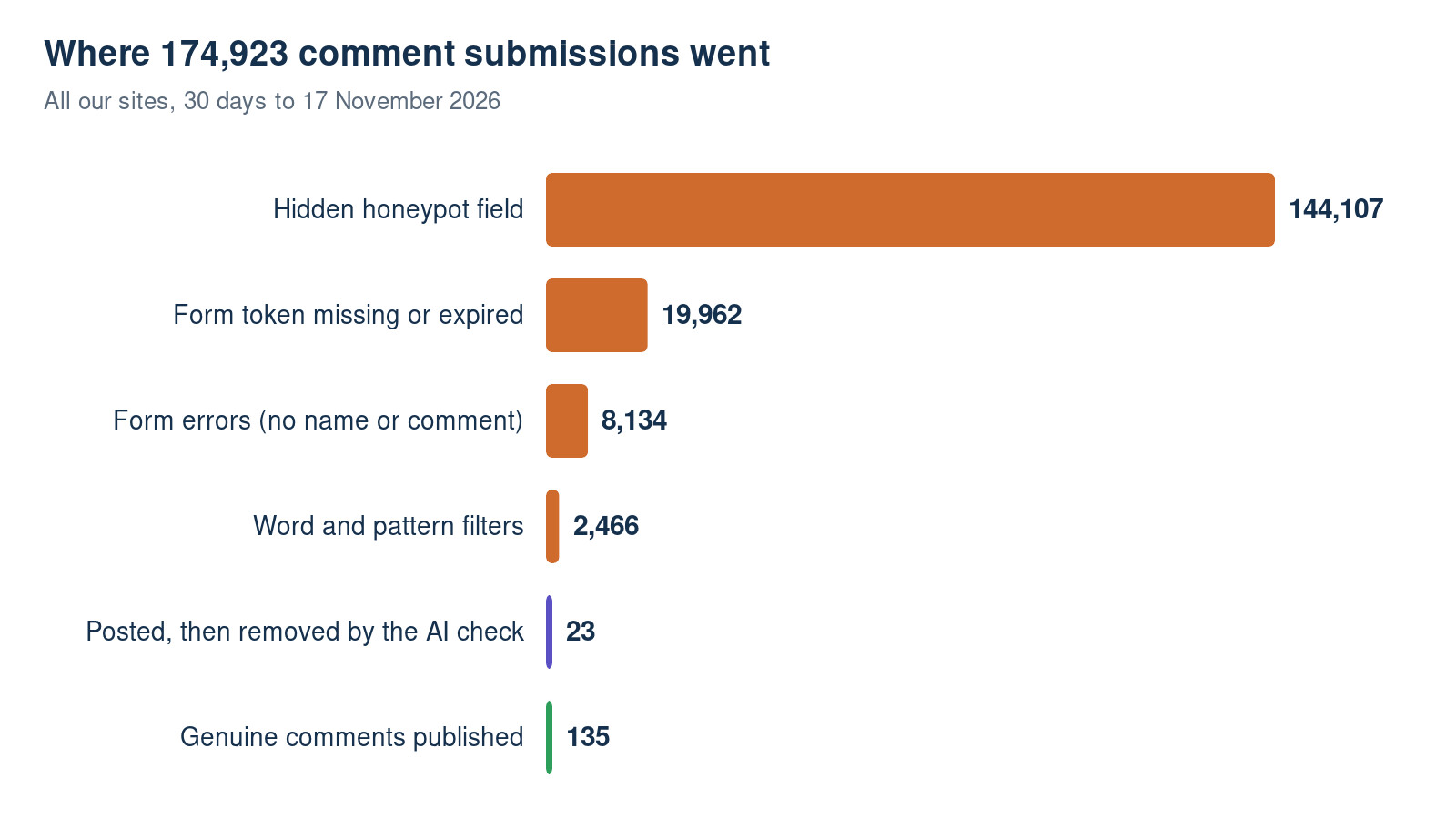
Every comment that is sent to our server is counted, and since 7 October 2026 we have also recorded exactly what stopped each one. Here is where the last 30 days went:
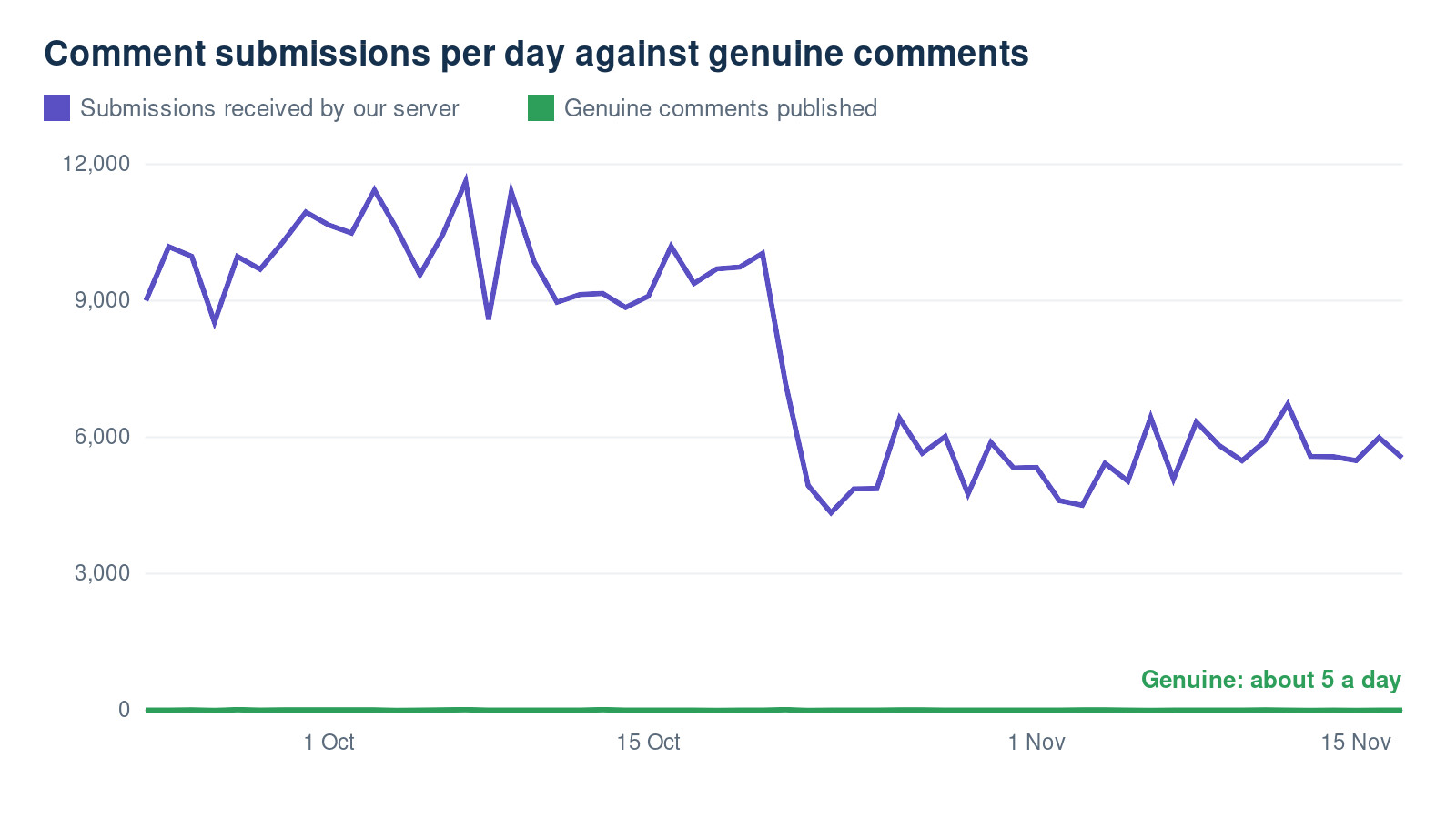
- An average of 5,831 submissions a day, from around 630 different internet addresses each day.
- About 5 genuine comments a day across the whole network: 291 in the 56 days we have counted.
- Spam volumes rise and fall on the spammers' schedule. Until 20 October we were receiving about 9,900 a day; since then it has been about 5,500.
No single check could handle that. We use four layers, cheapest first, so the expensive one only ever sees what the others let through.
Layer one: the honeypot
A honeypot is a box on the form that people cannot see. It is hidden from view, so a real reader never types in it. Spam software reads the page's code rather than looking at it, sees a box and fills it in. Anything that arrives with that box filled is rejected straight away.
It is by far our most effective defence. Since we started counting on 7 October 2026, the honeypot has caught 241,299 of the 256,149 submissions that reached our comment code: 94%. It costs nothing to run, and the reader never sees a puzzle or a pop up.
We keep a random 1 in 100 of the comments it catches, so we can check it is not catching real people. Of the 2,430 we have kept, 84% contained a link, and in more than a third the hidden box held a random 12 character string that looks like a generated password: the software was filling in every box it could find.
There is one trap. Browsers that fill in forms automatically can put a name or email address into a hidden box, and then a real person is rejected without knowing why. In November 2026 we found exactly that on the forms for our free tools: a hidden field filled by the browser silently stopped the button working for some visitors. Give your honeypot a name that does not look like a name or email field, and turn autofill off for it.
Layer two: the form token
Every comment form on our sites carries a one off code that the server issues when the page loads. Software that posts straight to our server without loading the page first has no valid code, and is turned away. In the last 30 days that stopped 19,962 submissions, about 11% of the total. Most website frameworks have this built in; ours, Laravel, does it by default.
A real reader who leaves a page open for many hours before commenting can also have an expired code, so the error should tell them to reload the page and try again, not just say no.
Layer three: the rules
Next come simple rules. Submissions with no name, no comment or a badly formed email address are rejected: 8,134 in 30 days. Then the word and pattern filters, which caught another 2,466. They look for things like:
- links in the comment, which genuine readers on our advice sites almost never include
- phrases that only appear in sales pitches, such as offers to redesign your website for free or requests for a link
- email addresses that look machine made, such as long strings of consonants
- the same comment sent twice
The repeat offenders are revealing. In the last 30 days, one internet address tried 357 times across 205 of our sites. Another tried 296 times on 296 different sites, exactly once each, which is how you stay under a limit that counts attempts per site.
Your situation may be slightly different. ask a question below ↓ and our editorial team will reply with our advice.
Layer four: the AI check
Whatever gets past all of that is read by an AI model, Anthropic's Claude Haiku 5.5. It scores each comment from 0 (clearly genuine) to 100 (clearly spam) and gives a one line reason. Under 30, the comment stays up. From 30 to 69 it is hidden for me to review. At 70 or above it is deleted, although we keep a copy so it can be restored.
This layer catches what rules cannot: polite, human sounding spam. A typical one: "Hi, quick question: who looks after the blog on [our site]? I have an idea for it." There is no link and no banned word, but it is a sales pitch. In the last 30 days, 191 comments got past the rules and were posted. The AI check and our hourly clean up removed 23 of them, and 135 are on our sites today. Of the published comments the AI scored, 140 out of 142 scored under 30.
If the AI cannot be reached, the comment goes through. A genuine reader should never be blocked because a supplier is having a bad day.
It is cheap. The instructions plus a comment come to around 550 tokens, so at Haiku 5.5's price of $0.10 per million input tokens and $0.50 per million output tokens, each check costs under a hundredth of a cent. Because the other layers come first, it reads only a couple of hundred comments a month and costs a few cents. If it had to read all 174,923 submissions, it would cost about $15 a month, and anyone with a spam script could run up our bill.
Getting the instructions right mattered. Our first version scored short, misspelt or non English questions from real readers between 35 and 75, which hid or deleted them. We rewrote it on 24 October 2026, and when we scored 516 past comments again, no genuine reader question scored 70 or more.
Where we got it wrong
Blocking spam is the easy half. The hard half is knowing what you blocked by mistake, because a genuine reader who is turned away simply leaves, and nobody tells you.
So we checked. Between 9 July and 7 October 2026, our word and pattern filters blocked and logged 9,007 comments. We took a random sample of 150 that contained a link and 150 that did not, and had two AI models, Claude Haiku and Claude Sonnet, label each one as genuine or spam without seeing the other's answer. They agreed on all 300, and the whole check cost 68 cents.
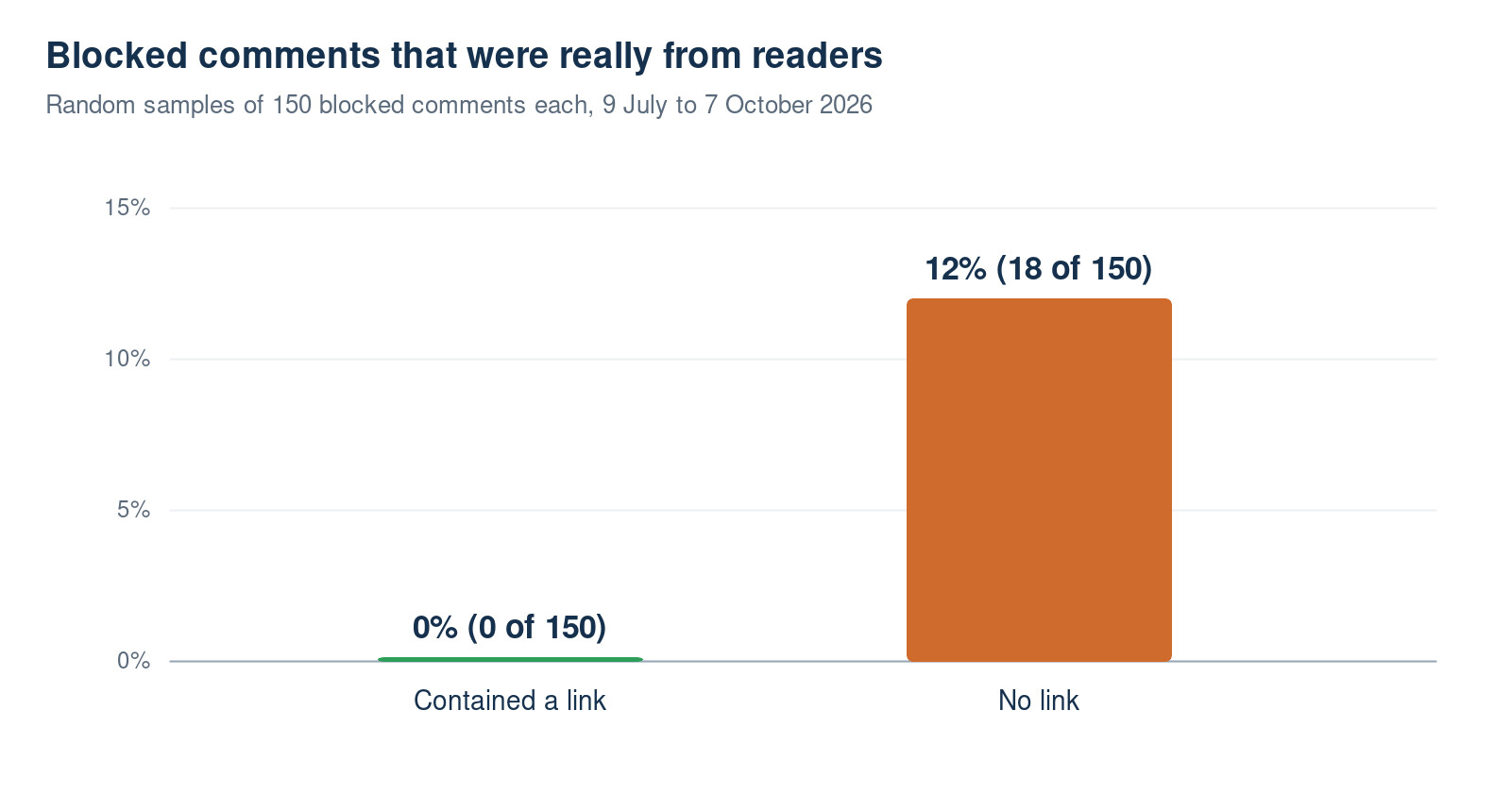
None of the comments with links were genuine, so that rule is safe. But 18 of the 150 without links were real readers, 12%. Scaled up, our filters blocked about 96 genuine comments in those three months, somewhere between 58 and 134, while 563 got through. Roughly one real reader in seven was being turned away.
The cause was single words. On our family law sites, parents describing abuse or a false accusation used the word "sex", and the filter treated that as spam: it accounts for 28 of the 89 wrongly blocked submissions we have logged so far, many of them the same reader trying again. Another rule blocking "cialis" also blocked every reader who mentioned a "specialist". Single words now only match at the start of a word, so "specialist" gets through, 10 wrongly blocked comments have been restored, and we are working through the rest of the rules they tripped.
One caveat: both labelling models are Claude, and I argue in Using Two AIs to Check Each Other that a model should not mark its own family's work alone. Here they were judging readers, not each other, but a sample is still queued for me to check by hand.
We have made a worse mistake before. In April 2026, Cloudflare's "are you human?" check on our comment forms quietly started rejecting every genuine comment, and for nine days nobody could post. That story is in How Cloudflare Bot Fight Mode Blocked Google From All Our Websites.
What I would tell any small business
- Start with a honeypot. It is free, invisible to readers and caught 94% of our spam on its own.
- Use the form token your website already has. It stops software that never loads the page.
- Block links if your readers do not need them. In our sample, not one blocked comment with a link was genuine.
- Be careful with single word bans. Real people use the same words as spammers, especially on sensitive subjects.
- Put the AI last. It catches the polite spam rules miss, and it stays cheap when it only reads what is left.
- Keep what you block, and check it. Without our sample we would never have known that one reader in seven was being turned away.



Ask Technology for Small Business a question
Ask our editorial team a question and we will reply with our advice. Tell us as much about your situation as you can: the more detail you give, the more useful our answer can be.
You do not need to use your real name. Please do not include your full address, phone number, email address, or the names of other people. We may edit or remove identifying details for privacy and legal reasons.
Comments are moderated before publication.