
Downstairs in our office there is a computer with two graphics cards that I bought to run AI. On one of our websites, Explore Astrology, people have had over 15,000 personal readings from our free astrology tools, such as the birth chart calculator, since we started counting in May 2026, each one written by Anthropic's Claude. So I had what looked like an obvious idea: use those readings to train an AI model of our own on that computer, so it could write them itself. I did not do it, because the terms do not allow it. And when you look at where the big AI models learned to write in the first place, that is hard to swallow.
The idea
Our astrology tools work in two parts. Our own code works out the facts: where the planets were at the moment you were born, which signs they were in, and so on. Claude then turns those facts into a reading in plain English. The facts are ours. Only the writing comes from Claude.
Training a smaller open model on thousands of examples of that writing is a well known technique, often called fine tuning or distillation. The result would have been a model that runs on our own hardware, writes in the same style and costs nothing per reading.
Cost was a big part of the reason. At the time the tools ran on Anthropic's Claude Haiku 4.5, at $1 per million tokens of input and $5 per million tokens of output, and every reading was a bill.
The hardware is a Dell Precision 7875 tower:
- two NVIDIA RTX 4000 Ada graphics cards, each with 20 GB of memory, so 40 GB in total
- an AMD Threadripper PRO processor with 12 cores
- 64 GB of memory and a 1 TB solid state drive
- Ubuntu Linux, with Ollama to run the AI models
Forty gigabytes of graphics memory is enough to run good open models, but not the best, and on their own they were not good enough for this work. Training one on our own readings looked like a way to close the gap. I wrote about the machine, what it cost and what it ended up doing in We Spent £5,000 on Our Own AI Server: What It Does and What We Learned.
We tested it first
Before training anything, we tested whether an open model on our own machine could write the readings at all. In October 2026 we took 20 real birth chart requests from the tool and had them answered twice, with exactly the same instructions and the same calculated chart: once by Claude Haiku 4.5, which was running the tool at the time, and once by OpenAI's open model gpt-oss, the 20 billion parameter version, running on our server downstairs.
Each pair of readings was then marked out of 10, blind, by two judges from different companies: Anthropic's Claude Opus and OpenAI's GPT. Neither was told which model wrote which reading, and each pair was judged twice with the order swapped, so the position of a reading could not decide the result. It is the same idea I describe in Using Two AIs to Check Each Other.
The results were not acceptable:
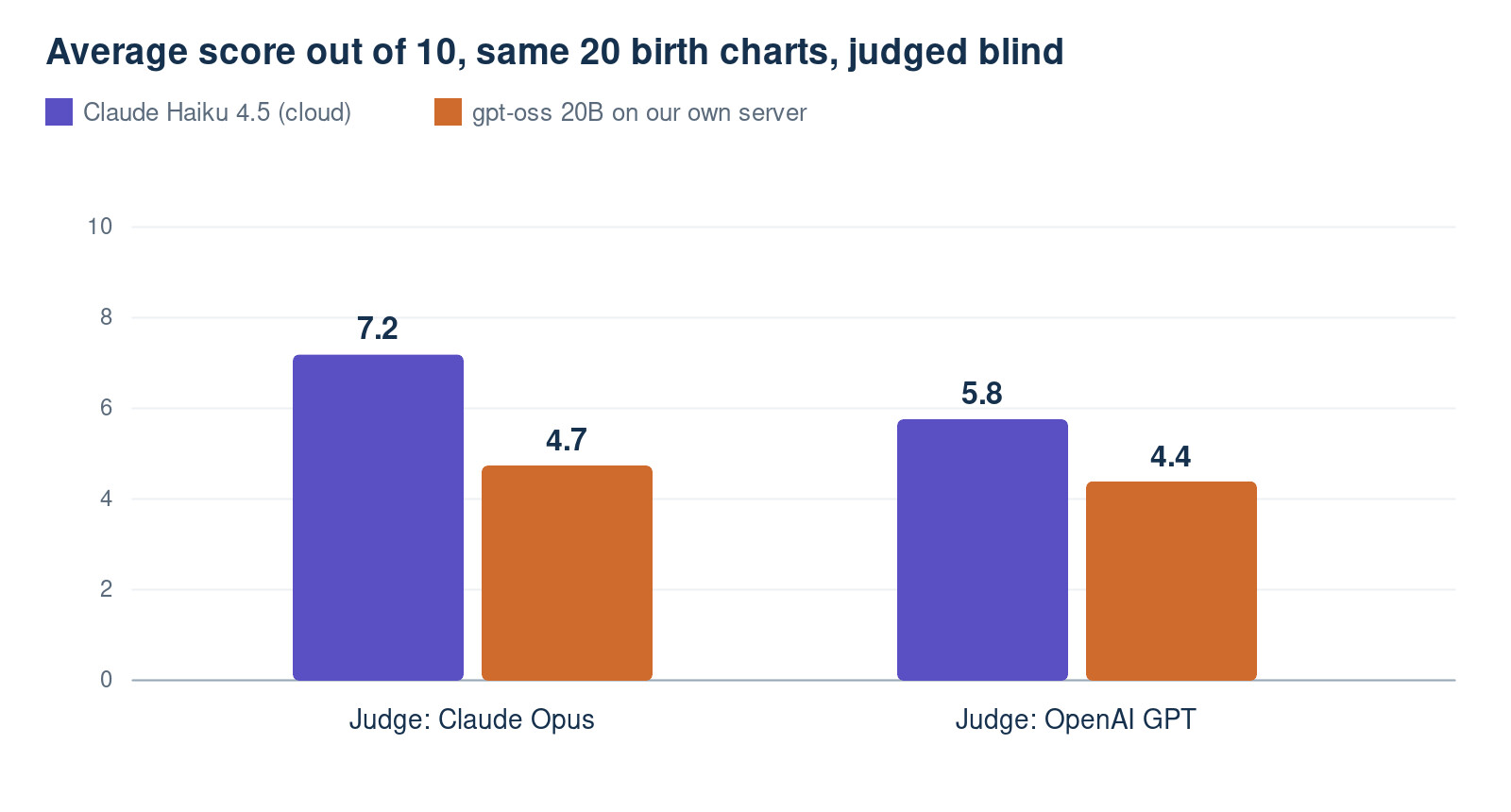
- Claude Opus scored Haiku's readings 7.2 out of 10 on average and our own model's 4.7. It preferred Haiku's reading on 18 of the 20 charts.
- GPT marked both lower but agreed on the order: 5.8 for Haiku and 4.4 for our model.
- Our model took about 33 seconds per reading, against about 16 for Haiku. Turning its reasoning down to make it faster cut its score to 3.8.
- Giving it the chart in a simpler, pre-digested form helped a little, but not nearly enough.
The full test, with every model and both judges' scores, is in Can an AI on Our Own Server Match Claude? How We Tested It.
Larger open models, too big for our machine but available from hosting companies, came much closer to Haiku. That is what made training look worthwhile: let a large model write the examples, then teach our small model to copy it. And the best teacher of all would have been one of Anthropic's own top models.
Then, on 7 October 2026, Anthropic released Haiku 5.5, which reasons through a problem before it answers, at $0.10 per million tokens of input and $0.50 of output: a tenth of the price. Run through the same test, it beat Haiku 4.5 on all 20 charts under Claude Opus and on 19 of 20 under GPT. The thinking uses more tokens, but since we switched, our own records show the cost per reading has fallen by about two thirds, from around $5.50 per thousand readings to under $2. Within a day the bought option had become better and cheaper than anything we could realistically build, and we moved every tool on our sites over to it.
What the terms say
Both of the big companies forbid it. Anthropic's commercial terms say a customer may not "access the Services to build a competing product or service, including to train competing AI models". Its usage policy, updated on 12 November 2026, goes further: you may not "use outputs to train an AI model (e.g., 'model scraping' or 'model distillation') without prior authorization from Anthropic".
OpenAI's terms of use say you may not "use Output to develop models that compete with OpenAI", and its updated usage policies, which take effect on 20 November 2026, tighten the rules on using its outputs to train other models. OpenAI does allow some training, such as fine tuning its own models through its own service, but not building a model to replace it.
Is a small astrology model in our office really a competitor to Anthropic or OpenAI? By any common sense measure, probably not. But Anthropic's policy now needs its permission for any training on its outputs, competing or not, neither company defines exactly what "competing" means, the readings are exactly the kind of thing their models are sold to produce, and I am not going to build part of the business on a legal grey area with the company that supplies the AI it runs on. The real risk is not a court case but Anthropic closing our account, which would switch off every tool on our sites, all to save about $8 a month on this one tool. So the readings stay where they are, and Claude keeps writing them.
The irony
Here is the part that rankles. These models learned to write by reading the internet, and the internet includes our websites. Our server logs show it. In the 30 days to 17 November 2026, requests identifying themselves as Anthropic's crawler, ClaudeBot, hit our sites 233,941 times. OpenAI's GPTBot made 48,801 requests, and Meta's crawler 479,891. For comparison, Googlebot made 259,261, so Anthropic's crawler alone is reading our sites almost as hard as Google does.
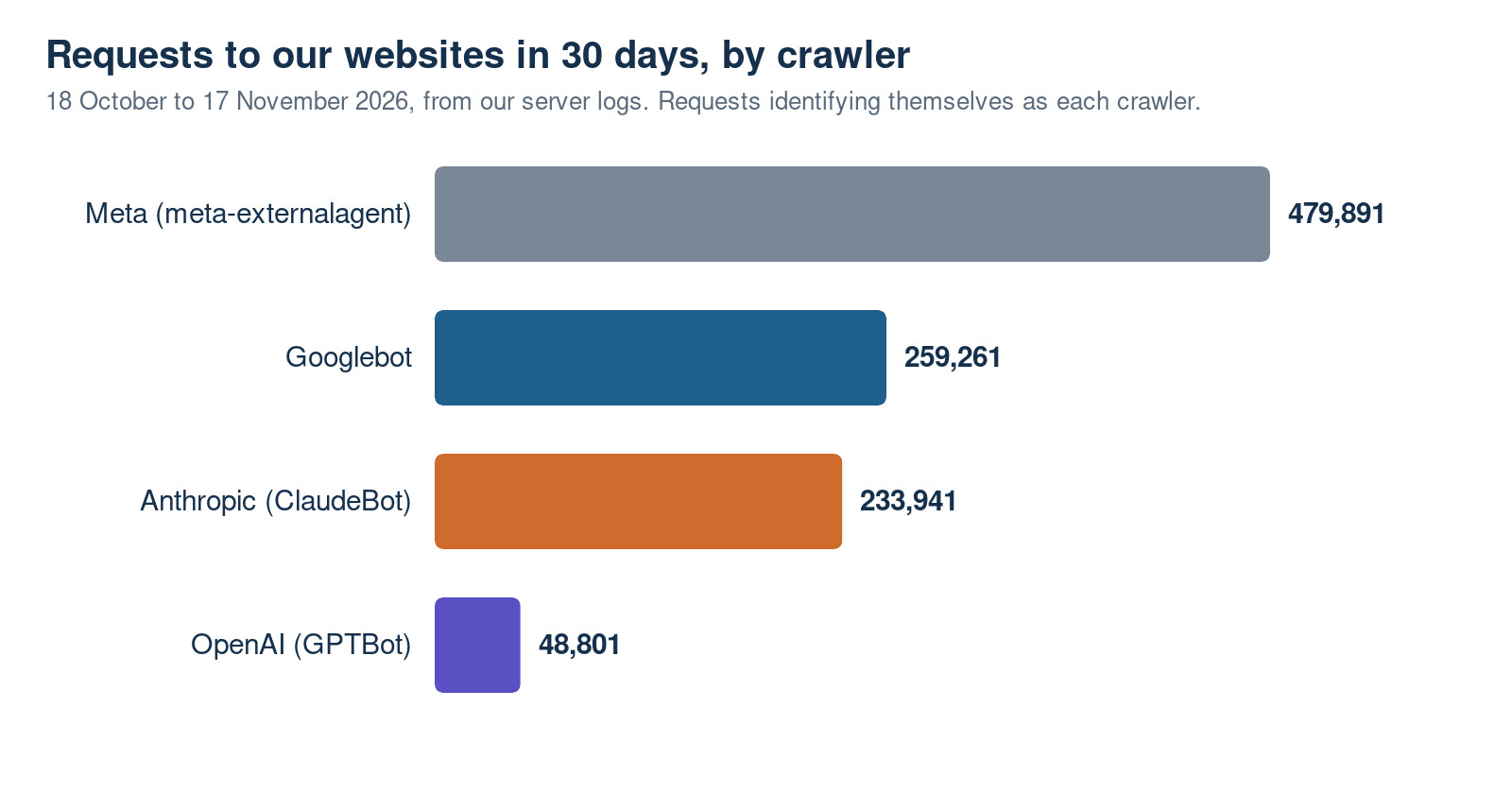
A request is not proof that a particular article ended up in a model. But both companies say their crawlers collect publicly available pages that may be used to train their models, and that is what these crawlers are doing on our sites every day.
Google at least sends visitors back. The AI crawlers read our 28,444 articles, written over almost twenty years, for models that are then sold back to us, with terms that stop us doing the same thing with what they produce. They can learn from everyone's writing for free. We cannot learn from theirs, even when we have paid for every word.
I do understand why they do it. A model can be copied surprisingly well by training on its answers, and that would let a rival skip years of work and billions in costs. But it is the same thing they did to the rest of us, just at a far larger scale.
Your situation may be slightly different. ask a question below ↓ and our editorial team will reply with our advice.
We tried to stop them once
At first, we did not want AI companies training on our articles at all, which is why we switched on a Cloudflare setting called Bot Fight Mode across our sites. It blocked Google too, and our Google search traffic all but disappeared for months. The full story is in How Cloudflare Bot Fight Mode Blocked Google From All Our Websites. If you do want to keep AI crawlers out, do it in your robots.txt file, which tells each crawler by name what it may read. OpenAI and Anthropic both say their crawlers follow it, and it cannot block Google by accident.
What you can do instead
- Train on your own material. Your own documents, emails and records are yours to train on, subject to the usual data protection rules for anything personal.
- Use an open model's output. Open models such as OpenAI's gpt-oss are released under the Apache 2.0 licence, which does not carry the same restriction. Check the licence of any model before you build on it, because they vary.
- Keep the clever part in your own code. In our tools the calculations are ours, and the AI only does the writing. If we ever change supplier, the part that matters comes with us.
- Read the terms before you plan. Check what you are allowed to do with an AI's output before you build anything that depends on it.
Where that leaves us
We still use Claude every day, and it is very good at the job. But the rules are lopsided. The AI companies want everyone's writing free and their own protected. For now, if you pay for an AI's answers, you can use them, publish them and sell them, but you cannot use them to train an AI of your own without the supplier's permission.


Ask Technology for Small Business a question
Ask our editorial team a question and we will reply with our advice. Tell us as much about your situation as you can: the more detail you give, the more useful our answer can be.
You do not need to use your real name. Please do not include your full address, phone number, email address, or the names of other people. We may edit or remove identifying details for privacy and legal reasons.
Comments are moderated before publication.