
One of our websites, Explore Astrology, has free astrology tools, the most popular being a birth chart calculator. People run more than ten thousand readings on them every month. It also sells personal reports, written for each buyer as a PDF, for £3.99 in the UK and the equivalent in other currencies.
I do not run the site to make money. It is a research project into how people behave online: what they use, where they stop, what brings them back and what, if anything, they will pay for. The reports, and the experiment in this article, are part of that research, and I write up what I find here. This is the story of a pricing idea I was sure would work, which we built, launched and took down again in the same day. Small businesses try ideas like this all the time, and I think the details are more useful than a success story.
Where we started
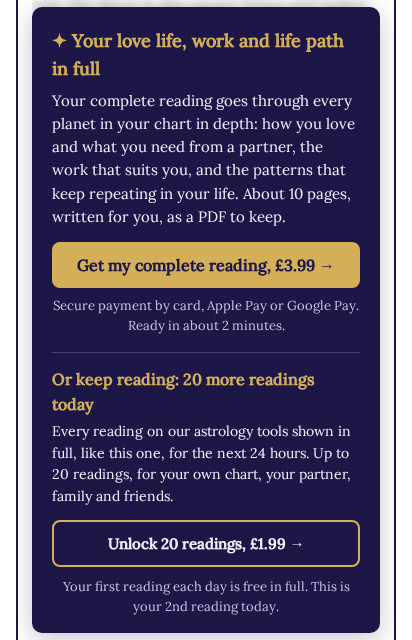
The free tools work like this. Your first reading each day is shown in full. From your second reading, part of it is blurred with an offer of the full report. That keeps the first reading complete for everyone, including Google, and only asks people to pay when they keep coming back.
The idea
Looking at how people used the tools, I noticed a group of keen visitors who ran reading after reading in a day: their own chart, a partner's, their children's, friends'. They hit the blurred reading again and again and never bought a report. A £3.99 report about one chart is not what they wanted. They wanted to keep playing.
So we built a day pass: £1.99 for up to 20 full readings over 24 hours, on every astrology tool. The lock box on the second reading offered both choices, the full report for £3.99 or 20 more readings for £1.99. At the same time we blurred more of the reading from the second one on, so the pass had more to unlock.
Building it properly
Even a small product needs some care.
- Enforced on our server, not in the browser. Each pass is a record on our server with a count of readings and an end time 24 hours after payment. Every reading checks with the server, so clearing the browser or copying a link does not get you more.
- One cookie, and the privacy notice updated. The browser holds a random code so our server can recognise the pass. A cookie that is needed for a service someone has paid for does not need a consent banner under UK rules, but it should still be named in your privacy notice, so we added it, along with a line explaining the pass.
- Local prices. Visitors saw the price in their own currency: $2.49, €2.29, ₹129 and so on.
- Straight back to the reading. After paying, the visitor came back to the tool and the reading they had been on ran again in full.
What happened
The day pass went live one morning, and I watched how people responded. The offer was seen through the day, and nobody clicked it. I took it down that evening, and put the blur back to how it was at the same time.
A few hours is far too short to prove anything, and I know that. But I did not want to leave it running long enough to find out, for two reasons.
- A cheaper option can pull buyers down. Someone who might have paid £3.99 for a report might take £1.99 instead. Telling those two apart would take months of data.
- More blur might have put people off. The free first reading is what brings people back, and blurring more of the second one risked making the whole site feel less generous.
Pricing questions take time to answer properly. Sometimes the sensible call is to go with your judgement and keep things simple.
Your situation may be slightly different. ask a question below ↓ and our editorial team will reply with our advice.
What went wrong along the way
I would rather share the mistakes too.
- We broke the tool pages for about a minute. The first version of the page change had an error that only showed up once it was live, and the astrology tools showed an error page until I put the old version back. After that, every change was checked on a copy before it went live.
- A visitor was shown dollars but charged pounds. When we added local prices, our page showed a price in dollars but the payment page charged pounds. The payment provider was choosing the currency from its own guess at the visitor's location. The fix was to tell it the currency every time, rather than leaving it to guess.
- Prices cannot be edited once set. When we lowered the price in one country, our payment provider would not let us change an amount it already held for a currency. We had to create new prices and switch over to them. For a short while the page showed the new price while checkout still charged the old one.
What I learned
- Watch who your keen users are, then ask whether they would really pay. The people running reading after reading were enjoying something free. That does not mean they wanted to pay for it. As research, that was the most useful finding of the day.
- Pricing tests need time. Even with thousands of readings a month, only a small share of visitors ever reach a paid offer, so measuring a new price option takes months, not a day.
- Check what customers see and what they are charged, in every currency. The dollars and pounds mix-up would have looked dishonest to the buyer, even though it was a mistake.
- Be willing to switch it off. The day pass took a day to build and ten minutes to remove. Keeping the code means I can bring it back if the picture changes.



Ask Technology for Small Business a question
Ask our editorial team a question and we will reply with our advice. Tell us as much about your situation as you can: the more detail you give, the more useful our answer can be.
You do not need to use your real name. Please do not include your full address, phone number, email address, or the names of other people. We may edit or remove identifying details for privacy and legal reasons.
Comments are moderated before publication.